
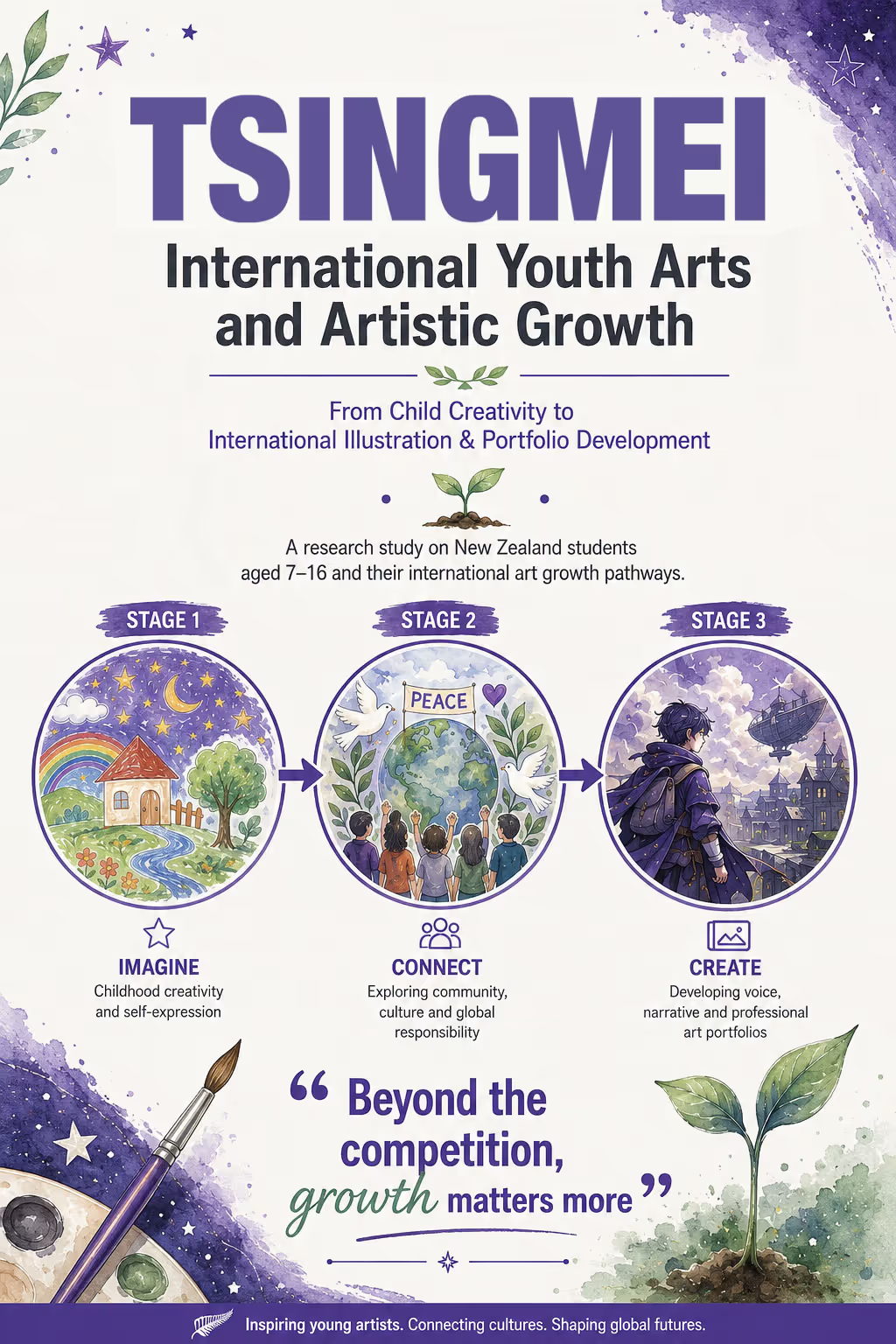
A Study on International Arts Growth Pathways for NewZealand Students Aged 7–16
– A Systematic Observation from Children’s Creativity, Community Art, toInternational Illustration and Portfolio Development
Foreword | Beyond the Competition – What Matters MoreIs Growth
In recent years, more and more New Zealand families have started paying attention to international art competitions. From children's drawing contests and public welfare poster campaigns to international illustration awards and youth art exhibitions, the number of events keeps growing. This has led many parents to ask: what kind of international art competition truly supports a child’s long-term development?
In arts education, a competition should never be just about winning awards. Rather than asking how many prizes a child has won, it's more meaningful to ask whether they have gradually built up their observation skills, their ability to express themselves, and the habit of thinking independently. At the same time, the differences between international art platforms are becoming clearer. Some focus more on children's creativity and free expression; others emphasize the matic research and social awareness; and some are moving closer to the logic of international publishing and professional portfolio development.
For New Zealand students, choosing the right platform for their stage of development is often more important than entering as many competitions as possible. This white paper aims to systematically sort out and analyse different types of international art platforms from the perspective of international arts education and youth development. It is designed to help families who want to nurture a long-term interest in the arts, develop a portfolio, or pursue overseas arts education.
Part1 | What Do International Art Competitions Really Look For?
Many people still think art competitions are about "how realistic the drawing is" or "how skilled the techniqueis." But in international arts education, what judges really care about often goes beyond technical ability. Especially as more international competitions align with the evaluation logic of art schools, whether a child has independent observation skills, original thinking, and the ability to consistently explore a theme has become more important than pure technique.
A strong piece of work is not just "finished to a high standard." It shows the creator’s way of thinking. For example:
- Can they identify a real-world problem?
- Can they observe it over time?
- Do they have their own perspective and visual language?
- Can they tell a complete story through a series of works?
At higher age levels, international judges increasingly look for signs that a child is beginning to develop their own visual language. In essence, an international art competition is not just a drawing contest – it’s a snapshot of a child’s visual thinking and creative growth.
Part2 | Different Types of International Art Competitions
Different types of competitions focus on different things. Some are great for younger children to gain international exposure; others help build thematic expression; and some are closer to the logic of international publishing, illustration, and portfolio development.
Child Creativity & Expression
Events like the JQA InternationalEnvironmental Children’s Drawing Contest focus on children’s perspectives and free creative expression. These competitions don’t over emphasise technique. Instead, they look at whether a child can observe theworld and express ideas in their own way. This makes them a good starting point for younger students to engage with international art platforms.
For students aged 7–10, keeping their creative interest and imagination alive is often more important than being"professional."
Social& Public Welfare Themes
Competitions like Lions Peace Poster Contest and EmbracingOur Differences place more weight on thematic awareness and the ability to observe society. These are often built around topics such as peace, inclusion, and community. They care more about whether a child can express an opinion through images rather than just produce a technically good piece.
For students who are beginning to think independently, these competitions help them understand that art is not just about drawing –it’s also a way to express and communicate.
International Illustration & Publishing
Platforms like Bologna Children’s Book Fair, BIBF, and Golden Pinwheel align more closely with the logic of the international illustration and publishing industry. Compared with traditional children’s drawing contests, these emphasise:
- Ability to create a series
- Storytelling and narrative skills
- Character and scene construction
- Personal visual style
For students who want to move toward illustration, visual storytelling, portfolio development, or arts-focused further education, these platforms offer strong long-term reference value. It’s worth noting that the Bologna Children’s Book Fair is more of an industry platform than a typical children’s competition. For younger students, it works better as a long-term goal or challenge.
International Exhibition Platforms
Platforms like OCIYAC / ART CAPITAL Youth ArtProject focus more on international art display and cross-cultural exchange. Their value lies more in expanding a student's international arts perspective than in the awards themselves. For some students, taking part in international exhibition projects can be a great way to learn about different cultures and artistic expressions.
Wearable Art & Cross-disciplinary Design
The World of WearableArt (WOW), based in New Zealand, is one of the world's best-known wearable art events. Although primarily designed for professional and emerging artists rather than young children, it provides an inspiring example of how visual art can expand beyond painting into fashion, sculpture, costume design, engineering, performance, and multidisciplinary creative practice. For students interested in design thinking, material exploration, and future creative careers, WOW represents an outstanding long-term aspiration and source of inspiration.
Part3 | Youth Arts Platforms in Australia & New Zealand Worth Knowing
Beyond international competitions, Australia and NewZealand also have some very strong local youth arts platforms. Unlike some highly commercialised international competitions, these local platforms tend to emphasise:
- Authentic creative processes
- Personal expression
- Exhibition experience
- Community and cultural connection
- Long-term artistic growth
For New Zealand students, these platforms are of ten closer to the local arts education system and serve as excellent supplementary pathways for long-term development.
Australia | The Lester Prize Youth Awards
One of Australia’s more representative youth portrait awards. It focuses on observational skills, emotional expression, visual storytelling, and individual perspective. Selected works are publicly exhibited. A strong platform for students starting to think about portfolios.
Australia | Waverley Youth Art Prize
A long-running youth art project in Sydney, open to students aged 9–18. It encourages free expression around a yearly theme and accepts various media, including drawing, mixed media, and experimental work. Emphasises contemporary youth perspectives, creativity, thematic research, and personal expression.
Australia | Young Archie Competition
Organised by the Art Gallery of New South Wales, this national youth portrait competition is inspired by Australia’s most famous portrait prize, the Archibald Prize. Open to ages 5–18, divided into age groups. Participants create a portrait of someone important to them. Judges look for observation skills, emotional authenticity, originality, and personal narrative.
Since 2013, it has become one of Australia’s most recognised youth portrait platforms. Finalists’ works are exhibited alongside the Archibald Prize at the Art Gallery of NSW. The judging process involves guest judges and gallery educators. Great for students wanting to develop character portrayal, portrait observation, visual storytelling, and portfolio-ready work.
Australia | Wild At Art – Threatened Species Art Competition for Kids
Organised by the Australian Conservation Foundation (ACF), Wild At Art is Australia's largest wildlife art competition for children aged 5–12. The competition encourages young artists to research an Australian threatened native animal or plant, create an original artwork, and accompany it with a short written reflection. Rather than emphasising technical drawing skills, the program promotes environmental awareness, scientific observation, creative storytelling, and conservation education. It provides an excellent opportunity for children to combine art with ecology while developing research, observation, and visual communication skills.
NewZealand | Secondary School Art Awards (formerly Wallace Secondary School ArtAwards)
One of New Zealand’s most representative secondary school art exhibition projects in recent years, run by The Arts House Trust and exhibited at Pah Homestead in Auckland. Open to Year 11–13 students nationwide.Each year, hundreds of submissions are whittled down to a shortlist, and winners are selected by guest judges and curatorial teams. In some years, over150 schools participate.
Unlike traditional children’s drawing competitions, this platform aligns closely with New Zealand’s contemporary arts education system. Its value lies in:
- Formal exhibition experience
- Contemporary artistic expression
- School art practice
- Public presentation skills
- Peer exchange among young creators
Media accepted include painting, photography, sculpture, ceramics, digital art, soft materials, and moving image. A highly recommended platform for students aiming for NCEA Visual Arts, international portfolios, Fine Arts, Illustration, or Contemporary Art.
NewZealand | Ringa Toi Student Exhibition
Organised by NZQA in partnership with several NewZealand arts institutions, this national exhibition focuses on Toi Māori andPacific Arts. Selected works are exhibited at Te Papa and other public cultural spaces. It emphasises indigenous cultural expression, Māori and Pacific visual languages, school art practice, and exhibition experience. Very representative of New Zealand’s local arts education system.
NewZealand | National Youth Art Awards
Run by the Waikato Society of Arts, this is one of NewZealand’s longer-running youth art awards. Open to ages 13–25, judged blindly.It leans more toward independent youth art practice and is well-suited for secondary students and those preparing for arts tertiary education.
NewZealand | reEarth International Art Prize (formerly ArtBeat New Zealand)
A children’s and youth art project that has gained attention in recent years. It emphasises children’s perspectives, community andcultural themes, free expression, and public art display. Open to ages 4–25,with public exhibitions and jury review. For younger students, it’s often more suitable as an introduction to artistic expression than traditional technique-driven contests.
Part4 | How to Plan International Art Competitions by Age
Different age groups are suited to different types of competitions.
Ages7–9: Building Interest and Observation
What matters most at this stage is maintaining creative interest, developing observation habits, and fostering free expression. "Skill training" is less important than whether the child wants to keep creating.
Recommended platforms: JQA, reEarthInternational Art Prize (ArtBeat New Zealand), and similar child-focused creative events.
Ages10–13: Beginning to Work with Themes
As children grow, they start to understand relationships between people, society, and the environment. At this stage, they can begin exploring:
- Public welfare themes
- Social issues
- Posters and visual communication
Competitions like Lions Peace Poster, EmbracingOur Differences, and Waverley Youth Art Prize tend to be more meaningful than purely technical contests.
Ages13–16: Gradually Building Portfolio Awareness
At higher age levels, international arts education increasingly looks for:
- Long-term project ability
- Series creation
- Personal visual language
- Thematic research
Students can begin exploring illustration, visual storytelling, and portfolio-oriented platforms such as BIBF, GoldenPinwheel, National Youth Art Awards, and The LesterPrize Youth Awards (as a long-term challenge).
At this stage, what matters more than "how many competitions you join" is whether you have started to develop a consistent creative logic.
Part5 | Why the Australian & New Zealand Arts System Differs from a"Prize-Chasing" Logic
Compared with some highly commercialised international competitions, the Australian and New Zealand youth arts systems tend to emphasise:
- Long-term creative processes
- Thematic research
- Personal expression
- Exhibition and community participation
- Reflective thinking
In this environment, whether you keep creating over time matters more than how many awards you have collected.Many strong students’ portfolios are built not through a pile of competition entries, but through long-term projects, series work, exhibition experience, and independent research themes.
Part6 | What International Art Schools Really Care About
Many parents mistakenly think: the more awards, the better. But in international arts admissions, schools care more about whether a student has:
- Long-term creative ability
- Independent thematic research
- Ability to develop a series of works
- Observation and thinking skills
- Personal visual expression
A student with a well-developed long-term project is often far more competitive than one with a stack of certificates. Because arts education has never been just about the result – it’s about how a child gradually builds their own way of expressing themselves through sustained creative work.
Part7 | 2026–2027 International Competition Reference List
Conclusion| Artistic Growth Is Not Just About Winning
For young people, international art competitions can certainly be an important growth experience. But the competition itself should never be the end goal. What truly matters is whether, through the long process of creating, a child learns to:
- Observe the world
- Express their own views
- Gradually develop a personal visual language
- Find a direction they genuinely love
At its heart, international arts education is always about growth – not just results.